Why My Website Isn't Ranking: 3 Technical Checks Hardin County Shops Miss
If a Hardin County contractor website isn't ranking, 80% of the time it's one of three technical issues: the site isn't mobile-friendly by Google's standards, the Core Web Vitals score is failing, or key pages aren't indexed. All three are fixable in a week, usually without a developer.
Most Elizabethtown KY and Radcliff KY business owners have been told their ranking problem is about content, keywords, or backlinks. That advice skips the foundation. Google cannot rank a page it cannot crawl, cannot load fast enough, or cannot render on a phone. The content conversation only matters after the technical floor holds.
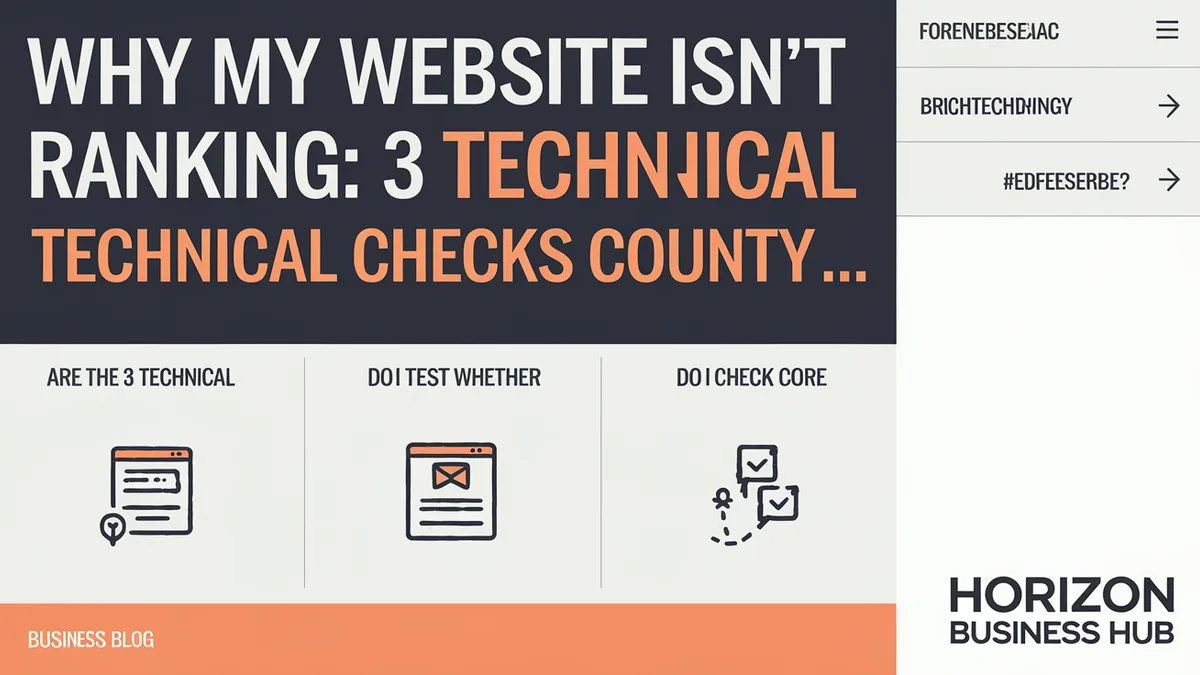
What Are the 3 Technical Checks That Decide Whether a Website Ranks?
The three technical checks are mobile-friendliness, Core Web Vitals, and indexing status. These are the pass/fail filters Google applies before it evaluates content quality or authority. A Hardin County KY shop can have the best copy on the internet and still not rank if any of these three fail.
Mobile-friendliness means the site renders correctly on a phone screen without horizontal scroll, with tap targets sized for thumbs, and with text readable without zoom. Since 60%+ of local searches happen on mobile, Google uses the mobile version of the site for ranking, not the desktop version. If the mobile experience is broken, the ranking signal is broken.
Core Web Vitals measure how fast the page loads, how stable it is while loading, and how quickly it responds to input. These are user experience metrics Google made into ranking factors in 2021. A site that looks fine to the owner on office wifi can fail Core Web Vitals on a phone using LTE in Radcliff KY traffic.
Indexing status is whether Google has actually added the page to its search index. A page that is not indexed cannot rank for any query. New pages, pages blocked by robots.txt, pages with noindex tags, and pages buried too deep in the site structure frequently get skipped by Google's crawler.
How Do I Test Whether My Website Is Mobile-Friendly?
Google retired its standalone Mobile-Friendly Test in late 2023, but the mobile usability section inside Google Search Console and the Lighthouse report inside Chrome DevTools both surface the same issues. Run the site URL through PageSpeed Insights at pagespeed.web.dev and review the Mobile tab. The report flags touch target sizing, viewport configuration, text legibility, and content width problems.
Common failures for Hardin County KY service businesses include buttons smaller than 48 pixels, text under 16 pixels, and images that force horizontal scroll on a 375 pixel wide screen. These issues usually come from a WordPress theme that was never properly tested on mobile, or from custom layouts built for desktop first without mobile breakpoints.
Open the site on an actual phone, not the desktop responsive preview. Try to tap a phone number, fill out a contact form, and scroll through a service page. If any of those three tasks feels awkward, a real customer in Elizabethtown KY trying to book a service call will bounce. Google measures bounce behavior and factors it into rankings over time.
How Do I Check Core Web Vitals, and What Scores Do I Need?
Core Web Vitals are measured at pagespeed.web.dev by entering the site URL. The report returns three numbers that matter: Largest Contentful Paint (LCP) must be under 2.5 seconds, Cumulative Layout Shift (CLS) must be under 0.1, and Interaction to Next Paint (INP) must be under 200 milliseconds. INP replaced First Input Delay (FID) in March 2024.
LCP measures how long the biggest visible element takes to render. On most contractor websites, that is the hero image. An unoptimized 4 MB JPEG from a phone camera will blow past the 2.5 second target on any mobile connection. Compressing that image to 200 KB and serving it in WebP format usually cuts LCP in half.
CLS measures how much the page jumps around while loading. Ads that load late, fonts that swap in after render, and images without width and height attributes all push the CLS score above 0.1. Fort Knox KY users on slower connections see the worst of this. Setting explicit image dimensions and preloading fonts fixes most CLS failures.
INP measures how long the site takes to respond when a user taps or clicks. Heavy JavaScript from tracking pixels, chat widgets, and page builders is the usual culprit. Removing unused plugins and deferring non-critical scripts often drops INP below the 200 ms threshold without any other work.
How Do I Verify My Pages Are Actually Indexed by Google?
Log into Google Search Console and open the Pages report under the Indexing section. This report lists every URL Google knows about and labels each as Indexed or Not Indexed with a reason. If the site has 20 pages and only 6 are indexed, 14 pages cannot rank for anything regardless of how good the content is.
Common Not Indexed reasons include "Crawled, not indexed" (Google saw the page but chose not to add it), "Discovered, not indexed" (Google knows the URL exists but has not crawled it yet), "Excluded by noindex tag" (the page tells Google to skip it), and "Blocked by robots.txt" (the site is telling crawlers to stay away). Each reason has a specific fix.
For any important service or location page that is not indexed, use the URL Inspection tool inside Search Console and click Request Indexing. That submits the page directly to Google's crawl queue. Pair that with adding the page to an XML sitemap and linking to it from the homepage or main navigation. Pages with no internal links are the most common indexing failure for small business sites.
A Hardin County KY contractor with 12 location and service pages should have all 12 indexed. If only the homepage shows up in Google when searching site:yourdomain.com, the rest of the site is invisible to search traffic.
What Should I Fix First When My Website Isn't Ranking?
Fix indexing first, then mobile-friendliness, then Core Web Vitals. Indexing is binary: a page is either in Google's index or it is not. There is no partial credit. Every hour spent on content or Core Web Vitals for a page that is not indexed is wasted work.
After indexing is sorted, fix mobile-friendliness next because Google uses the mobile version for ranking and because the majority of Elizabethtown KY and Radcliff KY customers are searching on phones. A site that loses mobile users loses revenue regardless of ranking.
Core Web Vitals come third because the scoring is gradient rather than binary. A site with a 3.0 second LCP ranks worse than a site with a 2.0 second LCP, but both can rank. Indexing and mobile failures are pass/fail. Core Web Vitals are a tiebreaker.
When Should I Blame Content Instead of Technical Issues?
Only after all three technical checks pass. If the site is indexed, mobile-friendly, and clearing Core Web Vitals thresholds, then ranking problems are usually about content depth, search intent match, or local relevance signals. At that point the conversation shifts to whether the service pages answer the questions real customers in Hardin County KY are typing.
A common pattern for contractors in Elizabethtown KY is a homepage that lists services but no dedicated page for each service in each service area. "HVAC repair Radcliff KY" and "HVAC repair Fort Knox KY" are different searches with different intent. One generic services page cannot rank for both, no matter how well written.
Content problems and technical problems look identical from the outside. The site is not ranking. The diagnosis requires checking the technical floor first, then looking at content only if the floor is solid.
Why Do WordPress Themes Often Cause Ranking Problems?
Most off-the-shelf WordPress themes are sold on design, not performance. A theme that demos beautifully loads 15 fonts, 8 animation libraries, and a page builder that outputs 400 KB of CSS before the first paint. That weight destroys Core Web Vitals scores on mobile connections common across Hardin County KY.
Page builders like Elementor, Divi, and WPBakery are the worst offenders. They generate nested div structures, inline styles, and JavaScript-dependent layouts that force the browser to do more work than necessary. A simple service page that should weigh 150 KB ends up weighing 2 MB.
The fix is either a performance-focused theme (GeneratePress, Kadence, or a custom block theme) or aggressive optimization of the current theme through caching, image compression, and selective script deferral. For a shop in Elizabethtown KY that depends on local search traffic, this is not optional.
Does Shared Hosting Cause Speed Problems That Hurt Rankings?
Shared hosting plans under $10 per month put hundreds of websites on the same server. When a neighbor site spikes in traffic, every other site on that server slows down. Time to First Byte (TTFB) on cheap shared hosting often exceeds 800 ms, which caps how fast LCP can possibly be regardless of image optimization.
Managed WordPress hosting (Kinsta, WP Engine, Cloudways) or a lightweight VPS typically delivers TTFB under 200 ms. That difference alone can move a site from failing Core Web Vitals to passing without touching the theme or content. For a Hardin County KY business generating leads through the website, the hosting upgrade usually pays for itself in one additional booked job per month.
Is Missing Schema Markup a Ranking Problem?
Schema markup does not directly boost rankings, but it unlocks rich results that increase click-through rates from search. LocalBusiness schema, Service schema, and FAQ schema tell Google exactly what the business does, where it operates, and what questions it answers. Sites without schema leave search real estate on the table.
For a contractor serving Fort Knox KY, Radcliff KY, and Elizabethtown KY, the LocalBusiness schema should list every service area and every NAP detail (name, address, phone). Missing or inconsistent schema is one of the fastest fixes for a site that ranks but does not get clicks.
Do I Need to Check HTTPS and SSL Setup?
Yes. HTTPS has been a lightweight ranking signal since 2014, and Chrome now marks non-HTTPS sites as "Not Secure" in the address bar. A site still serving on HTTP, or serving mixed content (HTTPS pages loading HTTP images or scripts), will lose both ranking and trust.
Check the SSL certificate by visiting the site and clicking the padlock in the browser. The certificate should be valid, not expired, and cover both the www and non-www versions of the domain. Expired certificates are a common failure mode for small business sites where nobody is watching the renewal calendar.
Pair the SSL check with a redirect audit: the site should have one canonical version (either www.domain.com or domain.com, not both) and every other variation should 301 redirect to the canonical. Duplicate versions split ranking signals and confuse Google's crawler.
How Long Does It Take to Fix These Three Issues?
For most Hardin County KY small business sites, all three technical checks can be addressed inside a week. Indexing fixes are often same-day. Mobile-friendliness fixes depend on whether the theme needs to change, but usually land inside two to three days. Core Web Vitals improvements through image compression, plugin cleanup, and hosting upgrades typically show up in the PageSpeed report within 48 hours of the changes going live.
Google then needs 4 to 8 weeks to re-crawl the site, re-evaluate the pages, and reflect the improvements in rankings. The technical work is fast. The ranking response is slow. That is why starting now matters more than waiting for a perfect plan.
Ready to Find Out Why Your Site Isn't Ranking?
A technical audit is the first step before any content, link building, or local SEO investment. Without a clean technical floor, every dollar spent on marketing works against a broken foundation. Horizon Business Hub runs technical audits for Hardin County KY contractors, service businesses, and shops that want a clear picture of what is broken and what to fix first.
The audit covers all three technical checks above, plus a review of the Google Business Profile setup and a gap analysis against the top three competitors in the local pack. The output is a prioritized fix list that any developer can execute, or that Horizon can implement as part of an ongoing local SEO engagement.
Hardin County KY, Elizabethtown KY, Radcliff KY, and Fort Knox KY businesses that want to know why their website isn't ranking can request the audit directly. No sales call first. The technical report comes back inside 5 business days and the recommendations stand on their own whether the business hires Horizon or not.
About Horizon Business Hub: Horizon Business Hub (HBH) is a veteran-owned marketing and operations firm serving Hardin County KY, Elizabethtown KY, Radcliff KY, and Fort Knox KY. Services include local SEO, Google Business Profile optimization, technical website audits, ad campaigns, landing pages, lead follow-up automation, AI auto attendants, and reputation management. Website: horizonbusinesshub.com
About the author

Justin Fernandez owns Horizon Business Hub (digital infrastructure for SMBs), Horizon Pack and Ship (two-location retail shipping in Radcliff and Elizabethtown), and Horizon Print Shop. He architects the agency stack from inside an actively-running multi-unit operation, not from a consulting chair. The goal is simple: bring enterprise-grade support to everyday businesses. What owners actually need, not what sounds impressive in a deck.
Read full bio →